Your Bay Is the Spec: Stone Tools for a Workshop With No Spare Floor
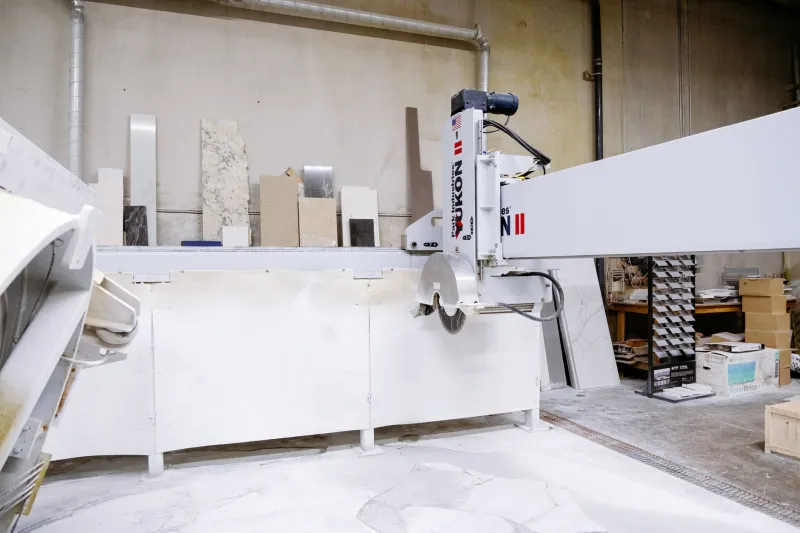
Most stone shops do not start with a purpose-built unit and a forklift turning circle. They start with a garage, a lock-up, a shared industrial bay or a strip of floor behind a yard gate. The temptation is to buy tools as though the bigger workshop is just around the corner. In a one-bay setup, that is how you end up with a floor-standing saw you cannot feed and a bench you cannot reach.
Here is the Kelso Stone Tools view: treat the bay as the specification. Buy for the work you can actually do in it, not the work you would like to advertise.
Measure the floor before you read a single spec sheet
Start with a chalk line and a tape, not a catalogue. Measure the clear floor, the door opening, the height under any racking and the turning space you need to swing a slab or a length of worktop. A machine can be the right size on paper and still be wrong because you cannot get a sheet past it or stand behind it.
Draw three zones: dirty and wet, clean and dry, and the bit in between where you store and move work. In a tight bay, those zones will overlap, so you need tools that can be moved or folded away when the job changes. That is a buying decision, not a tidying-up decision.
Benchtop or floor-standing? Buy the work, not the badge
Benchtop kit earns its place in a one-bay shop when the work is repeatable and relatively small: sink cut-outs, edge profiling, small polishing runs, core drilling with a stand, and cutting tiles or slips. A good benchtop wet saw with proper water control and a decent fence can do more than a cheap floor-standing saw that dominates the room.
Floor-standing machines make sense when you need the mass, the table size or the repeat accuracy for regular slab work. But they also demand clearance at the front, back and sides. If you have to move a bench, a compressor and a stack of offcuts every time you use it, the machine is not really installed. It is just parked.
A useful rule for a single bay: buy the largest machine you can use without rearranging the room, then spend the difference on workholding, water control and extraction. Those are the things that make a small shop productive.
Castors, fold-away benches and the art of clearing the deck
Mobility is not a luxury in a one-bay workshop. It is how you get two or three functions out of one patch of floor. Look for braked castors that can handle a wet, gritty floor, not office-chair wheels with a hopeful load rating. Retractable castors are worth considering on heavier benches: the bench sits solid when working, then lifts and rolls when you need the space.
Fold-away benches and wall-mounted trestles suit shops where the work comes in bursts. Check the hinges, the locking pins and the load rating. A folding bench that flexes under a stone blank is a false economy. If you are buying a mobile bench, think about where it will live when it is folded and whether the castors will survive slurry, dust and the occasional dropped offcut.
Route extraction and power before the tools arrive
In a confined space, dust and water do not stay in their lane. On-tool extraction is part of the tool, not an accessory you add later. Check that the extraction hose and water feed do not turn the machine into something you have to fight. If you are using water, plan where the slurry goes and how you will clean it up without walking it through the clean zone.
Power is the other invisible constraint. A single bay often has one ring main, a few sockets and a hopeful extension lead. Do not daisy-chain high-draw tools. Keep 110V site kit and 240V workshop kit on separate, sensible routes, use RCD protection where required, and get a competent person to check the setup if you are unsure. Route cables overhead or along walls so they are not sitting in wet slurry. A trailing lead is not a power plan.
Noise, neighbours and the limits nobody puts on the spec sheet
A garage under a flat, a terraced unit or a yard next to houses all have neighbours. Stone tools are noisy, and a one-bay shop often has less acoustic separation than a larger unit. Think about when you cut, not just what you cut with. Early-morning slab work and late-night polishing are the quickest ways to turn a working shop into a complaint.
Choose quieter options where they make sense, keep covers and panels fitted, and avoid running equipment unnecessarily. If noise is a genuine constraint, plan the loud operations into a sensible window and keep the bench work for the quieter hours. Local authority noise rules are not a reason to buy a worse tool, but they are a reason to buy with your working hours in mind.
Do not buy for the workshop you might have
The biggest trap in a single bay is optimistic capex. A larger saw, a bigger extractor, a second bench and a pallet of spares can all be justified by a future move that may never happen. In the meantime, they cost floor space, insurance, maintenance and the ability to turn around a job without moving three things first.
If a job needs a machine you cannot house, hire it or send the work out. That is not a failure of ambition. It is good buying. A one-bay shop that is honest about its constraints will usually beat a cramped shop full of kit that is always in the way.
A single-bay buying order that keeps you working
Start with the tool that does the most frequent operation, then add the support kit that makes it safe and clean: water containment, extraction, workholding and lighting. Buy mobility before you buy mass. Buy fold-away before you buy fixed. Buy for the door width, the ceiling height and the neighbour. Then, when the work really demands it, upgrade the machine and sell the old one.
At Kelso Stone Tools, the advice is simple: your bay is not a compromise version of a bigger workshop. It is the workshop. Choose tools that respect the floor, the power and the people around it, and you will get more done in one bay than many shops manage in three.