The Hole Is a System: Buying Core Bits That Suit Your Drill, Your Water and Your Wall
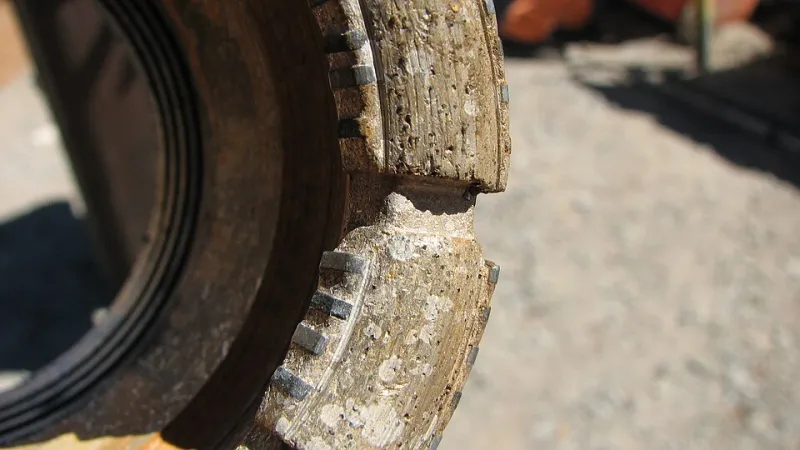
Photo: Rob and Stephanie Levy, CC BY 2.0, via Wikimedia Commons
A core drill looks like a simple purchase. You need a hole, you buy the thing that makes holes. Then the bit arrives, the motor smells hot, the core glazes over and the whole job turns into a lesson in false economy. In a UK stone shop, the bit is only one part of the system. The drill, the clutch, the water supply and the material all have a say in whether you get a clean hole or a burnt-out motor.
Start with the drill, not the diameter
It is tempting to choose a core bit by diameter and price alone. That is how people end up with a 110mm core on a drill that really wants to turn a 50mm bit in sandstone. Before you look at the catalogue, write down what you are actually running: the make and model of the drill, its rated torque, its no-load speed, whether it has a clutch, and what power supply it uses.
A core drill needs low speed and steady torque. A hole saw in a cordless drill needs something different again. If you are buying for a bench drill or a pillar drill, the shank and the chuck matter as much as the diamond. If you are buying for a handheld rig, the weight and balance of the bit matter because you will be holding it at chest height while water runs down your sleeve.
Do not assume that a bigger drill automatically means a bigger core. Some motors are geared for torque and some are geared for speed. A core bit that is too large for the gearbox will either stall or spin too fast, and neither is kind to the diamond segment.
Wet and dry are different jobs wearing similar clothes
Wet coring is the default for most stone work because water keeps the segment cool and flushes the slurry away. Dry coring has its place, especially on site where water is awkward, but it is not a straight swap. Dry bits are designed to run hotter and clear dust differently. Put a wet bit on a dry job and you can overheat the segment. Put a dry bit on a wet job and you may find the bond is too hard or the flutes do not clear the slurry properly.
For UK stone shops, the material matters. Granite and quartz are dense and abrasive. Limestone and sandstone are softer but can be inconsistent. Engineering brick is a different animal again. A bit that sails through limestone may glaze on a hard quartz surface if the operator leans on it and the water feed is poor.
If you are buying a set, do not buy one bit and expect it to do everything. Buy for the materials you see most often, then add the odd size as the work demands it. A small selection of good wet cores will usually beat a large box of cheap ones that all need replacing after a fortnight.
Shank, thread and the small print
The shank is where a lot of good intentions fall over. Core bits come with different connection types: direct-fit threads, hex shanks, SDS variants and adaptors. The drill you own may take one and not the other. Check the thread pitch and the adaptor length before you pay. A bit that needs an adaptor can work fine, but every adaptor adds a little run-out and a little more to check before the first cut.
Hole saws are just as fussy. The arbor, the pilot drill and the shank all need to match. A diamond hole saw with the wrong arbor is a paperweight with a nice coating. If you are buying for a cordless drill, check the chuck size and whether the saw is rated for the RPM your drill will actually deliver. Too much speed is a common reason for glazing and short life.
Also read the maximum RPM printed on the bit. It is not decoration. A core bit rated for 900 RPM will not thank you for being run at 2,500 RPM because the drill was set to 'fast' and left there.
Torque, clutch and the smell of hot motor
A clutch is not a luxury on a core drill. It gives you a fighting chance when the bit binds in a hidden void or a piece of rebar. If your drill has a clutch, buy bits that suit its torque range rather than forcing the motor to do work it was not designed for. If your drill has no clutch, be honest about the risk and keep the core size sensible.
Torque is the thing that gets misunderstood. More torque is not always better if the bit is dull or the water feed is poor. A powerful drill can hide a bad bit for a while, then punish you with a burnt armature. The smell of a hot motor is not a sign of progress. It is a sign that the system is out of balance.
110V, 240V and the site reality
In the UK, 110V site equipment is still the norm on many construction jobs, while 240V kit is common in workshops. The safety realities are different, and so is the practical setup. A 110V core drill may need a transformer and a sensible cable run. A 240V drill may need an RCD and a supply that can cope with the start-up current. Neither is automatically better; they are just different buying decisions.
Do not buy a bit that only makes sense on one voltage and then expect it to work everywhere. If the drill lives in the van and goes to sites, build the kit around 110V. If it lives on the bench, 240V may be perfectly sensible. The bit itself does not care, but the person holding it should.
The false economy of a glazed bit
Cheap diamond cores often look like a bargain until they glaze over in hard stone. A glazed bit stops cutting, so the operator pushes harder, the motor works harder and the hole takes longer. That is not just a bit problem; it is a labour problem, a motor problem and a schedule problem.
A good bit is not necessarily the most expensive one on the page. It is the one with a bond that suits your material, a segment that clears the slurry and a shank that fits your drill. Buy from a supplier who can tell you what the bit is designed for, not just what diameter it is.
A buying checklist for the van
Before you order, run through the basics: drill model and torque, power supply, clutch or no clutch, wet or dry, material type, required diameter, shank or thread, maximum RPM and water feed. If any of those are unknown, the bit is a guess. A guess is fine for a one-off hole in a garden wall; it is not fine for a shop that needs to turn a profit.
Kelso Stone Tools stocks trade-grade cores and hole saws for UK stone work, but the advice is the same whether you buy from us or elsewhere: match the bit to the drill, the water and the wall. The hole is a system. Buy the whole system, not just the shiny part.