The Bench-Side Bottleneck: Workholding Gear That Pays for Itself in a UK Stone Shop
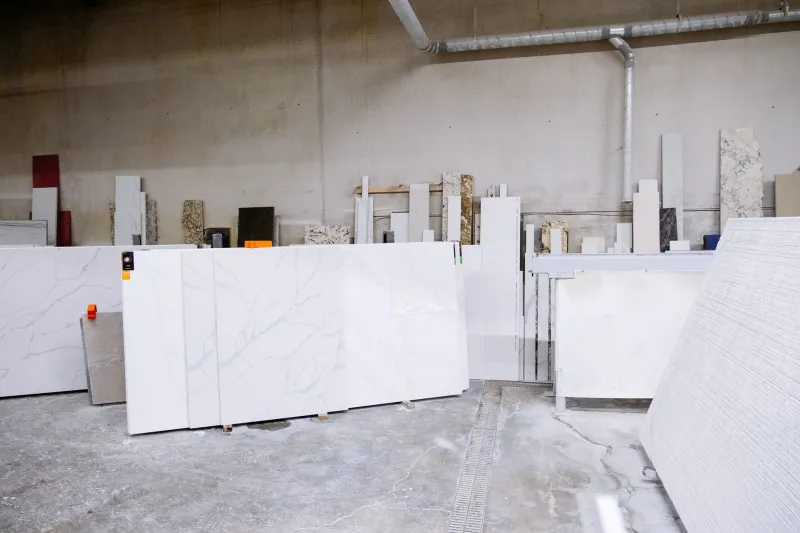
Walk into plenty of UK stone shops and you can guess where the money went. There is a decent saw, a rack of blades, maybe a polisher that cost more than a small van. Then look under the bench: a slab balanced on two offcuts, a sill held by a mate's boot, and a step that has been 'secured' with a scrap of timber and hope. Workholding is the line item nobody puts in the budget until something shifts.
That is the odd thing about this kit. It is not glamorous, it does not fill a catalogue page with glossy photography, and it rarely gets discussed over a brew. But it is the difference between a clean cut and a chipped edge, between a quick job and a two-man wrestling match, and between a near miss and an incident report. If you are kitting out a stone shop in 2026, workholding deserves its own line, not the leftovers.
Start with the load, not the clamp
The mistake is to buy clamps first and then look for something to clamp. A better approach is to think about what actually arrives in your workshop: 20mm worktops, chunky steps, long sills, drilled panels, maybe the odd reclaimed piece with a face that would rather be left alone. Each one has a different centre of gravity, a different cut direction and a different way of biting back.
A slab on trestles wants support underneath and restraint at the edges. A step being cut to length wants a flat, stable bed and stops that stop it sliding. A polished sill being drilled wants a pad or a jig that protects the face without pretending to be a permanent fixture. And a tall slab waiting for collection wants an A-frame and a strap, not a wall and a prayer.
Manual handling matters here too. If the workholding setup means two people are taking the weight while a third cuts, the kit is wrong. The holding gear should let the stone sit safely, so the operator can concentrate on the tool.
Trestles and A-frames: the foundation
Trestles are the first thing to get right because everything else sits on them. Look for a rated capacity that leaves headroom, not one that just about covers your average slab on a good day. A pair of folding trestles rated at 150kg each sounds fine until you put a heavy worktop on them and add a person leaning on the edge.
For UK workshops, wet conditions and uneven floors are part of the deal. Braked castors are useful if the trestles need to move; fixed feet are better if they do not. Adjustable height helps with saw alignment and save your back, but only if the adjustment mechanism locks positively. Rubber or polymer topping gives a bit of grip and reduces the chance of a polished face skating. Check the footprint as well: a narrow trestle is easier to store and easier to knock over.
A-frames are for vertical storage and transport prep. Buy one with a sensible load rating, straps that are actually attached to the frame rather than lost in a drawer, and feet that will not slide on a smooth concrete floor. If you regularly handle large slabs, a frame with a braked wheel or a secure locating pin is worth the extra. A cheap A-frame that flexes when loaded is not a bargain.
Clamps: buy for the stone, not the catalogue
Stone is not timber. It does not forgive a point load, it does not flex to meet a clamp jaw, and it does not appreciate being squeezed by something designed for a kitchen carcass. That does not mean every clamp needs to be specialist, but it does mean the jaws, pads and beam strength need a hard look.
F-clamps and bar clamps are the bread and butter. Check jaw opening and throat depth against the actual jobs you do, not the jobs you imagine. A clamp with plenty of opening but a spindly beam will deflect under load and give you less real holding force than the label suggests. Quick-release clamps are handy for repetitive work, but cheap ones can rack and slip. If the workshop is wet, plated or coated frames are easier to live with than bare steel that rusts at the first sign of a wet saw.
Soft pads are not a luxury on finished stone. Rubber or plastic jaw covers spread the load and reduce the chance of a bruise on a polished edge. For edge work, low-profile edge clamps can be more useful than a big F-clamp because they stay out of the tool's way. Buy a few decent clamps rather than a crate of vague ones. You will use them more.
Vacuum pads: useful, not magic
Vacuum pads are brilliant on the right surface and a trap on the wrong one. They like smooth, non-porous, well-supported material. They are less keen on rough sawn faces, dusty surfaces, porous stone or anything with a profile that breaks the seal. A gauge is not decoration; it tells you whether the pad is actually holding. A pump or venturi system needs a sensible air supply, and battery units need a charged battery and a plan for what happens when it runs out.
Use a vacuum pad as one part of the holding system, not the whole religion. A mechanical stop, a strap or a secondary restraint costs little and gives you a fallback. Test the pad on an offcut of the same stone before you trust it on the finished piece. And keep the sealing face clean. A pad that has been sitting on a dusty shelf is not the same as a pad that has been checked.
Bench stops, wedges and the boring stuff
This is the cheap end of the kit and often the most useful. Bench stops, wedges, shims and anti-slip matting do not look impressive, but they solve the small movements that ruin a cut. A slab that creeps 5mm during a wet cut can chip an edge or bind a blade. A wedge under a sill can take up the rock in an uneven bench. A strip of rubber matting can stop a polished face sliding while you set up a clamp.
Buy stops that can be fixed down or located in a bench slot, not just dropped on the surface. Wedges should be a sensible size and made of something that will not mark the stone. Shims are consumables; keep a box near the bench so people actually use them. This is the sort of gear that gets borrowed and never returned, so label it or keep it in a known drawer.
Where improvised holding gets expensive
The classic is the slab on two bricks. It works until it does not, and when it does not, the cost is a chipped edge, a damaged blade, a bruised shin or worse. The same goes for a step balanced on a saw horse while someone 'just holds it steady'. If the holding method relies on a person staying still and strong for the duration of a cut, it is not a method.
Vacuum-only setups on rough stone are another one. The pad holds just enough to encourage confidence, then loses seal at the wrong moment. Clamping a finished face without pads is a quick way to turn a saleable piece into a seconds item. And using the saw bench itself as the only stop, with no restraint against lateral movement, is asking a lot of friction.
The real cost is not just the damaged stone. It is the time spent reworking, the blade that got damaged, the job that slipped, and the fact that nobody wants to be the person explaining why the sill has a new corner. Good workholding is cheaper than most of those outcomes.
A sensible starter kit
For a small UK stone shop doing worktops, sills and steps, a practical starter kit looks something like this: a pair of rated trestles with rubber tops, one decent A-frame with straps, four or six bar or F-clamps with soft pads, a couple of low-profile edge clamps, a vacuum pad with a gauge if you handle polished slabs, a set of bench stops, wedges and shims, and a roll of anti-slip matting. Add a couple of straps and a trolley that can take the load. It is not a huge shopping list, but it covers most of the jobs that currently get held together by improvisation.
Buying checklist for 2026
Before you pay, ask what the gear is rated for, not what it is described as. Check whether it will live in a wet workshop without seizing or rusting. Look at the spares situation: replacement pads, straps and seals should be available. Make sure the clamps and trestles suit the stone you actually handle, not a catalogue fantasy. And think about storage, because workholding gear that is buried under a bench does not get used.
The saw and the blade get the attention, and fair enough. But the bench-side bottleneck is often the bit that holds the stone. Sort that out and the rest of the kit starts earning its keep.