Carbide, Cobalt and Clever Marketing: How to Read a Stone Tool Steel Spec Before You Pay
Photo: Harsch, John William, No restrictions, via Wikimedia Commons
Every workshop has the drawer. The one with the chisels that went blunt in a fortnight, the core drills that walked off line, the scraper that snapped at the braze rather than at the tip. Nobody throws them away, because nobody wants to admit what they cost.
Stone tool steels are a strange corner of the market. The material is a small fraction of the retail price, yet it decides everything about how the tool behaves. So when a supplier says "premium carbide" and leaves it at that, they're not being modest — they're declining to tell you the one thing that matters.
The badge is marketing; the grade is information
Tungsten carbide used in stone work is graded by cobalt content and grain size, usually written in the ISO K-series. A K10 grade sits around 6% cobalt with a fine grain: hard, wear-resistant, and unforgiving if you side-load it. Push up towards K20 and K40 and cobalt rises to 10–13%, the grain coarsens, and the material gets tougher at the expense of edge retention.
In practice: hard, fine-grained carbide suits limestone, sandstone, soapstone and anything abrasive-but-soft where you want the edge to last. Tougher, cobalt-rich grades suit granite, engineered quartz and anything interrupted or percussive, where chipping is the bigger risk than wear.
If a supplier can't tell you the grade, they don't know it. That is the whole test. Anyone buying carbide by the batch knows the designation, because they had to specify it.
Hardness figures, and what they hide
Carbide hardness is usually quoted as HRA (Rockwell A) somewhere between 88 and 93, or as HV30 in the 1,300–1,800 range. Transverse rupture strength — TRS, in MPa — is the toughness number, typically 2,000–3,000+ for decent stone grades.
Both figures are useful. Neither is sufficient. Hardness is a single number describing an average, and a badly sintered batch can hit its nominal hardness while carrying porosity that turns into a chipped edge on the third hole. This is why a spec sheet with an HRA figure but no batch reference is only half a document.
What you're really paying for is consistency. A tool that behaves the same on Monday as it did last Thursday is worth more to a fabricator than one that's marginally harder on paper.
Where cheap tools actually fail: the joint, not the tip
Most stone tool failures aren't metallurgical elegance problems. They're brazing problems.
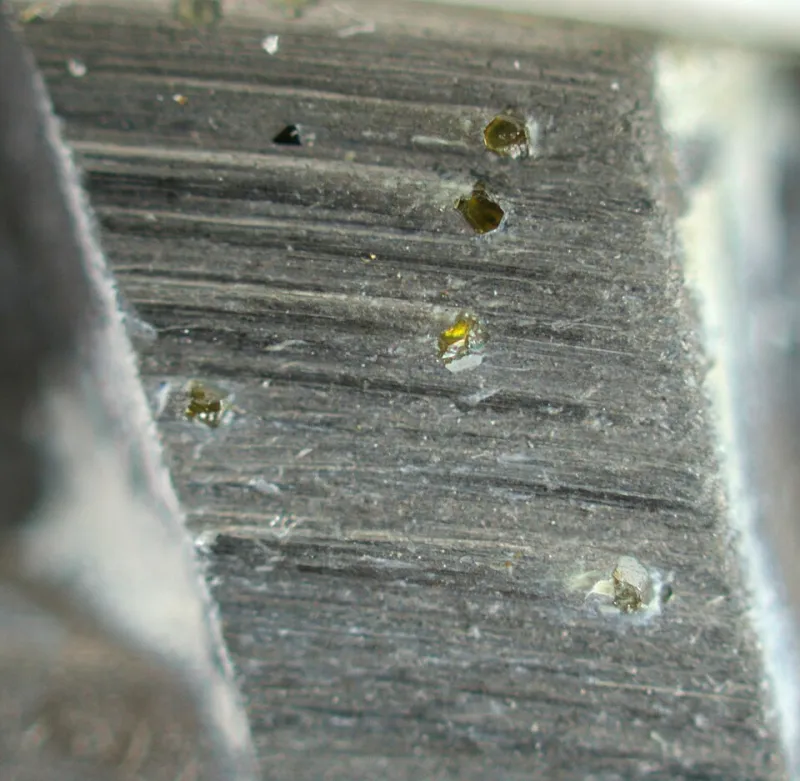
Carbide tips are joined to steel shanks with silver solder at roughly 700–800°C. Do it in a controlled furnace or by induction, and you get a thin, even, void-free joint. Do it with a torch by eye, and you get a joint with pockets in it. The tool will feel fine in the hand. It will fail at the braze line, usually at the worst possible moment, and usually on a job where the schedule is already tight.
The tell-tales are visible if you look: a dark or uneven braze line, a tip sitting fractionally proud on one side, discolouration running back down the shank. On diamond core drills, it's the steel core that matters — a thin-wall barrel that isn't true will wobble, and a wobbling barrel destroys the diamond segment long before the segment was due to wear out.
What you can realistically check before you buy
You are not going to run a metallurgy lab. You don't need to. Five questions do most of the work:
- What grade is the carbide, and can you put it in writing? Email is fine. A refusal is an answer.
- Do you have hardness and TRS values? Suppliers who quote both tend to know their supply chain. Suppliers who quote neither are reselling boxes.
- Where is the carbide sourced, and where is the tool assembled? These are often different countries, and that's not automatically a problem — but a supplier who can explain it is a supplier worth keeping.
- Can I buy a single unit to test? Anyone unwilling to sell you one chisel is telling you something about their confidence in the batch.
- What's the returns position if it fails in the first fortnight? Get it before you order a box of twenty.
Then look at the tool itself. Ground flutes rather than as-pressed. Consistent edge geometry across a batch. No visible porosity on the tip. A shank that sits straight in a collet.
The first-week edge test
Spec sheets settle the argument before purchase. The first week settles it afterwards.
Pick a known material and a known quantity — thirty 8mm holes in 30mm black granite, or a set run of Portland limestone moulding — and log it. Note how many holes or linear metres you got per tip, per charge, per blade. Do the same with your existing tool on the same material. Two hours of bookkeeping in week one will save you a year of guessing.
Watch three things while you do it:
- Heat. A tool running hot is rubbing, not cutting. That's geometry or grade, and it won't improve.
- Wear pattern. Even flank wear is normal. Chipping, cratering or a polished tip means the grade is wrong for the job.
- Sound and feed pressure. If you're leaning on it, the tool is fighting the stone.
Beyond performance, there's the dust question. Cobalt binders and respirable crystalline silica are a serious combination, and HSE has been consistent about it for years. A tool that cuts cooler and faster generates less respirable dust per metre drilled — which is a health argument as well as a productivity one. Water suppression and proper RPE still do the heavy lifting, but tool choice isn't neutral.
Red flags worth walking away from
Unmarked boxes with a sticker on the lid. "Premium quality" as the only descriptor. Prices sitting 60% below the trade norm with no explanation of how. No batch traceability on a consumable that fails dangerously. And the classic: a supplier who gets defensive when you ask what the cobalt content is.
The short version
Pay for the grade and the brazing, not the sticker on the box. Ask two questions, get them in writing, test one unit in week one, and keep a log. That's the whole discipline — and it puts you ahead of most of the trade.